I’m Confused About Cybersecurity — What Do I Actually Study to Get a Job?
You search for a cybersecurity course in Kochi, and within minutes you’re buried under terms like ethical hacking, SOC analyst, penetration testing, cloud security, and digital forensics.
At some point, the real question hits:
What should I actually study to get a job?
If that feels familiar, you’re not alone. Most beginners don’t struggle because cybersecurity is too difficult. They struggle because there’s no clear direction.
Let’s break it down in a way that actually makes sense.
Cybersecurity Course in Kochi: What You Really Need to Learn
Before choosing any course, understand one simple truth:
Cybersecurity is not a single subject. It’s a combination of skills built step by step.
Instead of trying to learn everything, focus on three layers.
1. Foundation Skills (The Part You Should Not Skip)
This is where clarity begins.
Basics of computers and operating systems
Networking fundamentals (IP, DNS, TCP/IP)
Linux basics and command line
Think of this as the base. Without it, advanced topics won’t make sense.
2. Core Cybersecurity Knowledge
Once your foundation is strong, move into core concepts.
- Network security basics
- Web security fundamentals
- Introduction to cryptography
- Security tools like Wireshark, Nmap, and Burp Suite
Here’s something important: most entry-level jobs don’t expect you to be an expert hacker. They expect you to understand systems and tools.
3. Specialization (Where Careers Take Shape)
This is where most students get confused.
Instead of learning everything, choose one direction:
- SOC Analyst
- Ethical Hacking
- Network Security
- Cloud Security
Clarity comes from choosing one path, not multiple.
Cybersecurity Course in Kochi: Skills vs Syllabus
Many students focus on finishing a syllabus. But companies look for skills.
Syllabus-Based Learning
- Covers many topics
- Focuses on theory
- Gives a sense of completion
Skill-Based Learning
- Hands-on labs
- Real-world scenarios
- Practical problem-solving
If your course does not include practical training, it will not prepare you for a job.
Cybersecurity Job Roles Explained Simply
Understanding roles makes choosing easier.
SOC Analyst (Best Starting Point)
- Monitors security alerts
- Identifies threats
- Works in security operations centers
This role is beginner-friendly and widely available.
Ethical Hacker
- Finds vulnerabilities
- Tests system security
This requires strong fundamentals and consistent practice. It is not an entry-level shortcut.
Network Security Engineer
Secures networks and systems
Manages firewalls and configurations
A good option if you enjoy networking concepts.
Cloud Security Specialist
Protects cloud platforms like AWS and Azure
This role has high demand but requires additional cloud knowledge.
Ethical Hacking vs SOC Analyst
| Factor |
Ethical Hacking |
SOC Analyst |
| Entry Difficulty |
High |
Medium |
| Practical Skills |
Advanced |
Moderate |
| Job Availability |
Moderate |
High |
| Beginner Friendly |
No |
Yes |
| Career Growth |
High |
High |
A practical approach is to start as a SOC analyst and later move into ethical hacking.
How to Choose the Right Cybersecurity Course in Kochi
Not every course will help you reach your goal.
Use this checklist before enrolling:
Includes hands-on labs
Starts with networking basics
Covers real-world tools
Offers placement guidance
Focuses on a clear job role
If a course promises to teach everything quickly, it is usually not structured properly.
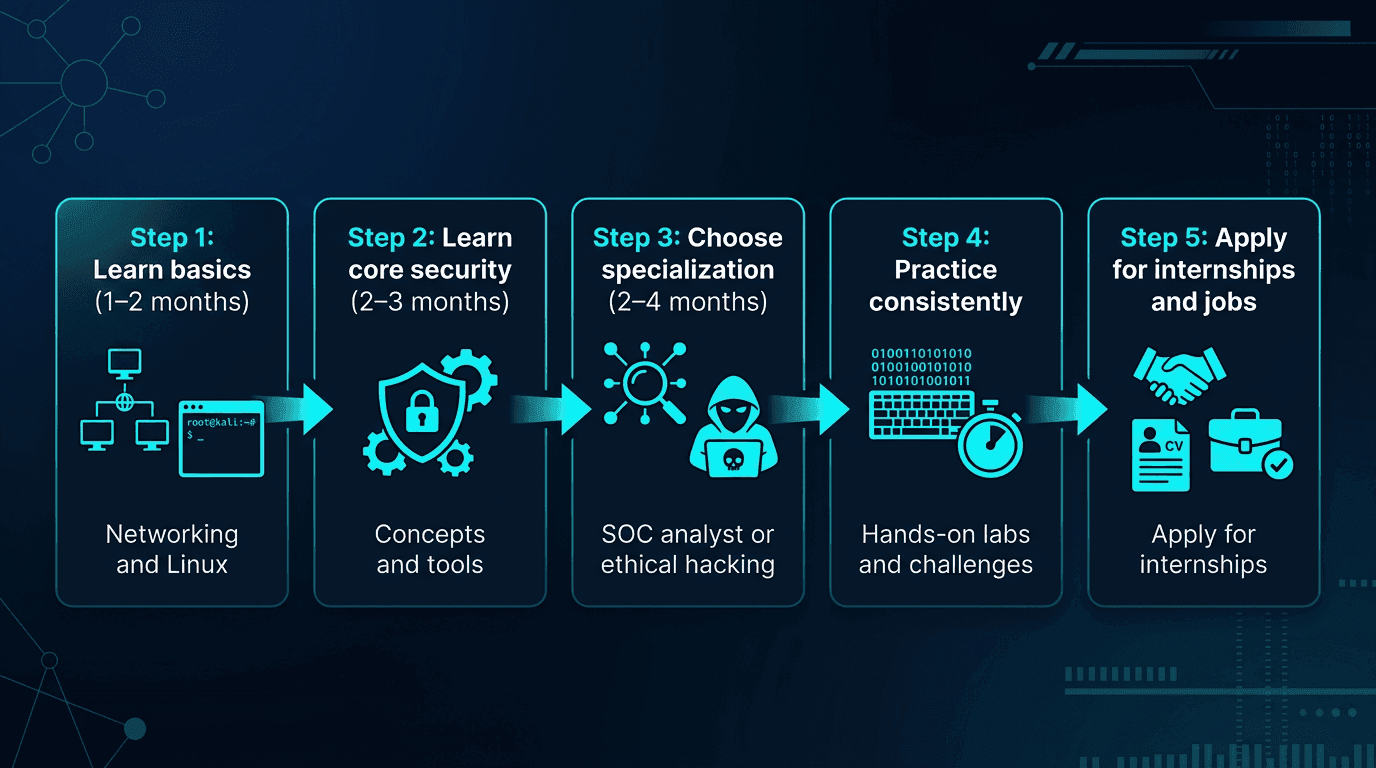
A Simple Roadmap to Follow
If you need a clear path, follow this:
Step 1: Learn basics (1–2 months)
Networking and Linux
Step 2: Learn core security (2–3 months)
Concepts and tools
Step 3: Choose specialization (2–4 months)
SOC analyst or ethical hacking
Step 4: Practice consistently
Hands-on labs and challenges
Step 5: Apply for internships and jobs
Progress matters more than speed.
Common Mistakes to Avoid
- Starting ethical hacking without basics
- Learning randomly without structure
- Trying to learn everything at once
- Ignoring practical training
Avoiding these mistakes can save months of confusion.
What Should You Actually Study?
If you want a direct answer:
Start with networking and Linux
Move to cybersecurity fundamentals and tools
Choose SOC analyst as your first role
Then build your career step by step.
Conclusion
The confusion around cybersecurity does not come from lack of information. It comes from too many options without direction.
A good cybersecurity course in Kochi should not just teach topics. It should guide you toward a specific job role.
Instead of asking which course is best, start by deciding which role you want to achieve.
That decision will bring clarity to everything else.
FAQ Section
1. Which cybersecurity course in Kochi is best for beginners?
A beginner-friendly cybersecurity course in Kochi should start with networking basics and include hands-on lab training focused on job roles like SOC analyst.
2. Can I get a cybersecurity job without coding?
Yes. Entry-level roles like SOC analyst do not require coding, though basic scripting can be useful later.
3. How long does it take to become job-ready in cybersecurity?
It typically takes 4 to 8 months with consistent learning and practice.
4. Is ethical hacking suitable for beginners?
It is a strong career path, but beginners should first build fundamentals before specializing.
5. What skills are most important for cybersecurity jobs?
Networking basics, Linux knowledge, security tools, and problem-solving skills are essential.