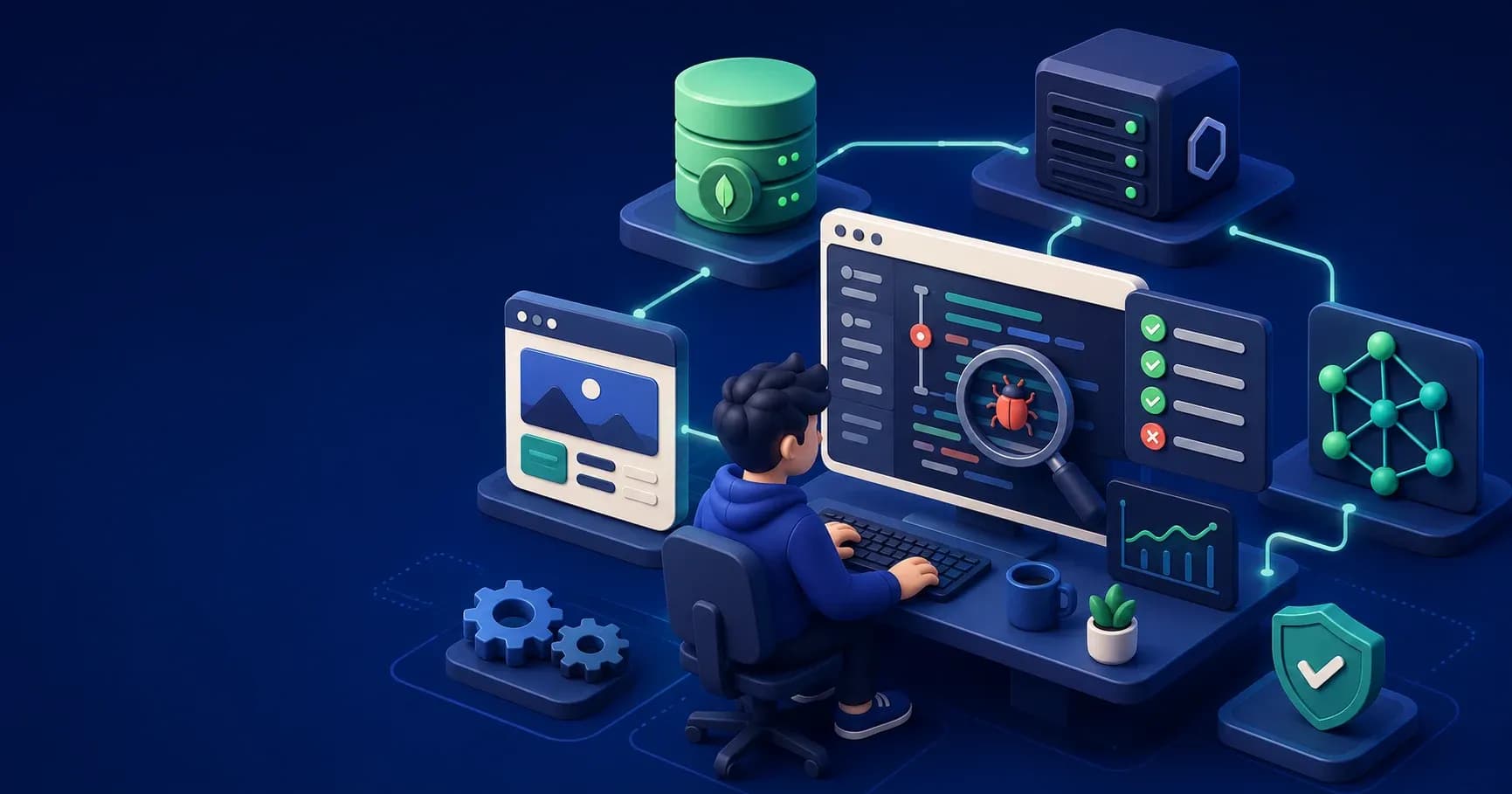
Testing and Debugging MERN Applications: What Kochi's Best MERN Full Stack Training Actually Teaches You
Ever build something in React or Node that worked great on your machine, felt proud of it, pushed it live… and then, watched it fall apart the second a real user touched it?
If you’ve been there, you already know the quiet truth nobody tells beginners: writing code is the simple part. Making sure that code doesn’t quietly implode in production, that’s the real work.
This is exactly where most self-taught MERN developers get stuck. They can craft a to-do app, a sign in screen, maybe even a full e-commerce prototype. But then you ask them to add a unit test, track a memory leak, or figure out why an API call just… fails silently, only on Tuesdays for one particular user, and suddenly everything gets very still.
That gap is precisely why testing and debugging deserve far more attention than they usually get - and why it's one of the core pillars taught in serious MERN full stack training Kochi programs build their curriculum around.
Why Testing and Debugging Are the Real Skill Gap in MERN Development
Here's a question worth sitting with: if two developers can both build the same feature, but only one of them can prove it works and fix it when it doesn't - who would you actually hire?
Testing and debugging aren't glamorous. No one puts “I wrote 40 unit tests” on their portfolio the same way they show off a polished UI. Yet every hiring manager at a product org knows the difference between someone who just codes and someone who delivers trustworthy software.
Did you know? According to multiple industry surveys developers spend about 35-50% of their day not writing brand new features, but mostly reviewing, testing and repairing code that already exists. That's not a side task - that IS the job, most days.
This is why any course claiming to be the best MERN stack course in Kochi has to go far beyond "here's how to build a CRUD app." A genuine training program needs to teach you how to break your own code before a user does.
The MERN Stack's Hidden Complexity: Four Layers, Four Ways to Fail
MongoDB, Express, React, Node - each layer has its own personality, and each one fails differently.
Frontend Bugs (React)
State that doesn't update when you expect it to. Components re-rendering endlessly. Props drilling gone wrong. I really like how React works in a way until I am looking at a screen that does not show the right information even though I know the data is correct. React is great because it is simple. Sometimes it can be frustrating when the screen does not show what I know is the right data.
Backend Bugs (Node & Express)
Unhandled promise rejections. Middleware executed in the wrong order. Routes that work in Postman but break the moment the frontend calls them with slightly different headers.
Database Bugs (MongoDB)
Schema mismatches, missing indexes causing painfully slow queries, and the classic "it works until the collection has more than 500 documents" surprise.
Integration Bugs (The Space Between Everything)
This is where most real-world debugging happens - not inside one layer, but in the handoff between them. A frontend expecting data.user.name when the backend just renamed the field to fullName. These bugs don't show up in isolated testing. They show up in production, at the worst possible time.
Understanding how these four layers talk to each other and fail to - is a core part of any structured MERN stack course with placement Kerala programs offer, because employers genuinely test for this during interviews.
Testing Strategies Every MERN Full Stack Student Should Master
Let's get practical. Testing in MERN isn't one thing, it's a layered strategy.
- Unit Testing - basically testing single functions on their own , with stuff like Jest. Like, does this particular function do the thing it claims to do, every single time?
- Component Testing - with React Testing Library, you check that UI bits render correctly and react to user inputs, kind of without needing the whole browser experience.
- API Testing - confirming your Express endpoints send back the proper HTTP status codes , the right data shapes, and that they deal with wrong or messy input in a calm way, usually with Supertest or Postman.
- Integration Testing - Making sure the frontend and backend actually talk to each other correctly, not just individually.
- End-to-End (E2E) Testing - acting out a real persons path through the entire app, using Cypress, starting maybe from login , then checkout, then logout, all the way through.
And here’s the simple truth : skipping tests doesn’t really save time. It only shifts the cost from “writing tests today” to “fixing a nasty production incident at 11 PM.” One is scheduled. The other one ruins your evening.
Debugging Tips That kinda separate beginners from professionals
Anyone can add a console.log(). Professionals debug systematically.
A few habits worth building early:
- Use browser DevTools properly - the Network tab tells you far more than most people realize about failed requests
- Try reading the stack trace, rather than just skimming it like you’re in a hurry. Don’t panic. Actually follow what it’s saying.
- Use Node’s built-in debugger or VS Code breakpoint debugging. It’s better than peppering console logs all over the place, and then forgetting what each one means.
- When you log, log with purpose-not just “something went wrong here”. A log with context plus timestamps and the relevant variable states, that kind of detail really resolves issues, not just highlights them
- Also, reproduce the bug consistently before you touch the code. If you can’t reproduce it, any “fix” you attempt is basically blind guessing
Think about it like this: would you spend 10 minutes reproducing the bug, reliably… or would you spend 3 hours randomly editing code, hoping it magically works? Beginners often pick the second road, without noticing they’re doing it.
Tools That Make Testing and Debugging Easier
A few tools genuinely worth learning well:
- Jest – for unit and integration testing across both frontend and backend
- React Testing Library - for testing components the way users actually interact with them
- Postman / Insomnia - for manually testing and documenting API behavior
- Cypress - for full end to end browser checking
- MongoDB Compass - for visually inspecting your database and spotting schema mismatches early
- Chrome DevTools & Node Inspector - for live debugging while things break, not after the fact
Knowing the theory behind testing matters, but knowing which tool to reach for in a given situation is what a good MERN full stack training Kochi program should actually train you to do through hands-on projects, not just slides.
Why This Matters for Your Career, Not Just Your Code
Recruiters and technical interviewers have caught on. It's now extremely common for MERN interviews to include a debugging round - where you're handed broken code and asked to fix it live, or a testing round where you're asked to write test cases for a given function.
This is precisely why placement-focused programs put real weight behind this skill. A genuine MERN stack course with placement Kerala students trust isn't just teaching you to build projects - it's preparing you to survive the technical rounds where testing and debugging knowledge gets directly evaluated.
if your training only covers “how to build”, and skips that part about “how to verify and fix” , then you’re basically only getting half the education you’re paying for.
Book Free Career Counselling
Quick Self-Check: Are you debugging-ready, like for real?
Ask yourself, honestly:
- Can you write a basic Jest unit test, without looking it up again every time.
- Do you know how to read a Node.js error stack trace, and then zero in on the exact line that caused the trouble
- Have you used Cypress ( or something in that same family ) to test a complete user journey, start to finish
- Can you explain the difference between a 400 and a 500 error without pausing, first?
- Do you test your API endpoints before wiring them into the frontend, or after everything is already broken?
If most of your answers were "no" or "not really," that's not a failure - it's simply a sign of where structured, mentor-led training helps far more than solo YouTube tutorials ever could.
MERN Full Stack Training Kochi : Students Need to Build the Skill That Actually Gets You Hired
Anyone can follow a tutorial and build a working app once. What separates a hobbyist from a job-ready developer is the ability to test that app rigorously and debug it calmly when something inevitably breaks - because in real production environments, something always eventually breaks.
This is exactly the gap that quality MERN full stack training Kochi offers is designed to close - not just teaching you to write code, but teaching you to trust it, verify it, and fix it under pressure.
If you're serious about becoming job-ready rather than just tutorial-ready, this is the skill worth mastering next. Explore the MERN Stack course in Kochi and see how hands-on, project-based training can get you there.
Learn more about mernstack course
FAQ
1. Why is testing kinda important like building features in MERN development?
Because untested features can turn into unpredictable features. Testing shows your code works in multiple conditions not only in the one scenario you tried manually.
2. Do I have to learn testing separately, or does it come inside a MERN stack course in Kochi?
Most of the time, a good MERN full stack training Kochi program includes testing and debugging as a core module, since it matters for your interview readiness and also for real job work.
3. What’s the most common debugging mistake beginners do?
They change code randomly, without first reproducing the bug in a consistent way. If you can’t reproduce it reliably, then you’re basically not debugging, you’re just guessing.
4. Which testing tools should a beginner in MERN learn first?
You should start with Jest for unit checks, React Testing Library for UI pieces, and Postman for API verification. Once you’re comfortable enough with those then move towards Cypress for end-to-end verification, ok.
5. Does knowing testing and debugging really help during placements?
Yes, it does. A good number of MERN role interviews now have live debugging stuff or test-writing tasks included, so that’s why many MERN stack courses with placement Kerala support put a heavy focus on it too.
Stay Connected with Us